
Why one daily number doesn't work for Morocco
A single daily figure for Morocco hides almost everything that matters. Someone staying in hostels and using intercity buses is planning a fundamentally different trip from someone booking boutique riads and hiring private drivers, so this guide gives verifiable reference prices where they exist and explains the categories that actually move the total.
The useful way to think about a Morocco travel budget is by category: accommodation, long-distance transport, food, local transport, activities and the things people often forget. Once you know where money actually goes, you can decide where to spend more and where to save.
Reference prices checked for this guide
These figures were checked in October 2026 against the sources linked below. Euro amounts are rounded and use the Bank Al-Maghrib reference rate of about 10.89 MAD per euro reported for 9 September 2026. Treat them as reference points for planning, not as quotes: rail fares in particular change with demand and booking date.
Sources: train and coach figures are independent reference fares from Seat61's Morocco rail guide; live train prices should always be checked on the official ONCF booking site. The exchange-rate reference is reported by Bladi.net. The September 2026 fuel reference comes from Hespress. Monument prices are taken from the official Moroccan Ministry of Culture ticketing service.
Accommodation: the biggest variable
For the trade-offs between riads, hotels, medina access and road-trip stays, see the Morocco accommodation guide.
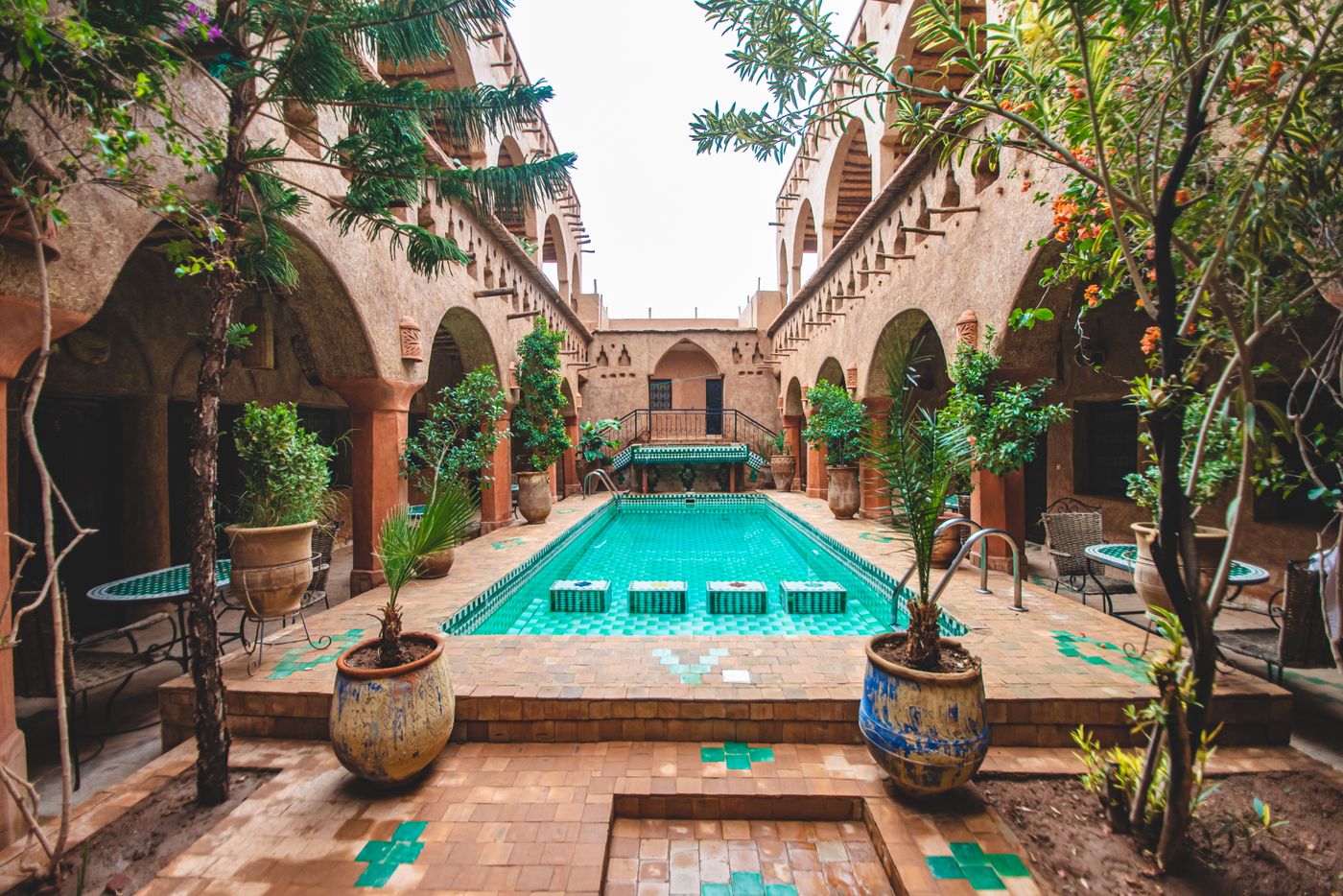
Morocco offers everything from basic guesthouses to luxury riads, international hotels and desert camps. The Moroccan National Tourist Office lists riads, guesthouses, hotels, campsites and bivouacs among the country's accommodation types, which is why one "average price" tells you almost nothing. Official accommodation overview.
This is the one major category where this guide deliberately gives no reference price. Room rates depend so heavily on city, dates, standard and location inside or outside the medina that any single figure would mislead more than it helps. Price it by searching your actual dates and cities, then use the descriptions below to judge what each level usually includes.
Budget accommodation
Hostels, simple guesthouses and basic riads. Breakfast may or may not be included. Shared bathrooms are common in hostels. Location inside medinas can be awkward for luggage. Quality varies widely at this price point, so reviews matter more than photos.
Mid-range accommodation
Comfortable riads in good locations, small hotels and well-rated guesthouses. Breakfast usually included. Private bathrooms. This is where you start finding places with genuine character rather than just functional rooms. In Marrakech and Fes, staying in or near the medina becomes practical rather than a logistical problem.
Higher-end accommodation
Boutique riads, luxury desert camps, well-known hotels and properties with pools, terraces or exceptional design. Service levels rise significantly. Meals and transfers may be included in desert properties. At this price you are paying for both comfort and location.
Where location matters most: In medinas, paying slightly more for a riad near a main gate can save daily frustration if you have luggage or need frequent taxi access.
Long-distance transport: choose the route before pricing
Transport costs depend entirely on your itinerary. Trains and coaches keep city-to-city travel affordable and predictable. Rental cars add fuel, parking and potentially tolls. Private drivers add comfort but move the trip into a different cost category. Multi-day desert transfers usually bundle transport, accommodation and some meals, so compare them as a package rather than as transport alone.
Trains
Morocco's rail network connects Tangier, Rabat, Casablanca, Marrakech and Fes, with the Al Boraq high-speed line running between Tangier and Casablanca. ONCF, the national operator, uses fare conditions that vary by train, date and ticket type. As an independent planning reference, Seat61 lists Al Boraq fares between Tangier and Casablanca at 99–224 MAD in 2nd class, and daytime Tangier–Marrakech journeys at 186–338 MAD. The gap between the lowest and highest fare on the same route is large, so check the ONCF site for your exact dates rather than assuming either end. For a city-heavy itinerary, trains are usually the best value. See our complete transport guide for route planning.
Coaches
CTM and Supratours serve the towns the railway does not reach, including Essaouira and Chefchaouen. As a reference, Seat61 gives about 110 MAD for the Supratours coach between Marrakech and Agadir, and notes that Marrakech–Essaouira costs slightly less. Booking ahead online is possible on major routes, and the main intercity services are generally comfortable.
Rental cars
Rental rates vary with company, season, vehicle type and how early you book, so get quotes for your own dates. Fuel is easier to estimate from a dated reference: Hespress reported diesel at around 15 MAD a litre in early September 2026. Treat that only as a September 2026 snapshot and check the current pump price before budgeting a road trip. Add parking and motorway tolls on routes that use the autoroute. A rental car makes most sense for the southern route through the Atlas, Dades and toward Merzouga—not for days spent inside medinas. Read our driving guide for route advice.
Private drivers
Hiring a driver removes the stress of mountain roads and long desert drives but significantly increases transport costs. Some drivers include the vehicle and fuel; others charge separately. Always clarify what is included before agreeing a price. This option makes most sense for groups or if nobody enjoys driving. Ask for at least two written quotes for the same route and number of days so you can compare like with like.
Desert tours and transfers
Multi-day trips from Marrakech through the south to Merzouga typically include transport, some meals, accommodation and a desert camp. Group size, accommodation standard and season change the price more than anything else. Always check exactly what is covered—one quote may include all meals, another just breakfast. Our desert route from Marrakech shows the stops these trips usually cover, which helps you judge whether a quote is for a rushed or a realistic schedule.
Food: the easiest place to control spending
Food is one area where you can adjust spending without ruining the trip. You can eat simply most days and splurge on one or two memorable dinners. Restaurants facing the busiest squares, such as Jemaa el-Fnaa in Marrakech, usually charge more than places a few streets away.
Budget eating
Street food, small cafés, local restaurants away from major tourist areas. Tagine, couscous, sandwiches, harira soup, fresh juices. Simple meals in local spots are often both affordable and better quality than tourist-oriented restaurants charging much more.
Mid-range eating
Sit-down restaurants in medinas, riad dinners, decent cafés. Set menus, traditional dishes prepared with more care, better service. This is the comfortable middle ground for most travellers.
Higher-end eating
Well-known restaurants, rooftop dining with views, hotel restaurants, special tasting menus. At this level you are paying for ambiance, location and presentation as much as the food itself.
Breakfast tip: Many riads and guesthouses include breakfast. When it is included, that removes a meal cost from your daily budget and makes the accommodation better value than it first appears.
The gap between eating mostly at street stalls and small cafés and eating every meal in tourist restaurants is large, which makes food the category where your own choices matter most. See our food guide for what to try and how to avoid tourist-oriented menus.
Local transport: taxis and short transfers
Inside cities, petit taxis handle short trips around town. Grand taxis serve longer routes and can be shared. Fares vary by city, distance and whether meters are used. Airport transfers to city centers vary depending on the city and whether you use an official taxi or pre-book. Rabat and Casablanca have trams, a cheap option when they match your route.
Local transport costs depend on how much you move around each day. Days spent walking one neighborhood cost almost nothing; days hopping between distant sites add up quickly.
Activities, entries and guides
Many of Morocco's most interesting experiences—walking medinas, exploring souks, visiting viewpoints—are free. Paid entries add up when you visit several sites a day, and guides add a further daily cost.
Monument entries
Palaces, madrasas, museums and gardens typically charge entry fees. Official Ministry of Culture prices vary by site: for example, Bahia Palace and Badii Palace are listed at 100 MAD for a foreign adult, while the Menara Pavilion is listed at 60 MAD. Privately run gardens and museums set their own prices, so check each one on its official site. If you plan two or three paid sites a day in Marrakech or Fes, entries become a real budget line rather than a rounding error.
Guides
Official guides can be useful in dense medinas like Fes. Unofficial guides may offer lower prices but vary wildly in quality. If you book a guide, agree the price, duration and what is included before you start walking. Rates depend on city, language, duration and whether you book officially or negotiate directly.
Desert activities
Camel rides, sandboarding, quad biking and other desert activities are often offered as add-ons to desert camps. Prices depend on duration and whether you book independently or through your accommodation. Verify what activities are included in your desert package before assuming they cost extra.
What people often forget to budget
- Tips: Tipping is common in many tourism and hospitality situations, including guides, drivers, restaurant service and riad staff. The amount depends on service quality and trip length.
- SIM cards or data: A local SIM with data makes navigation much easier. Prices and packages vary by operator and duration.
- Bottled water: Small daily cost that adds up, especially in summer.
- Snacks and drinks: Tea, coffee, fresh juice, pastries between meals add to daily spending.
- Luggage porterage: If your riad is deep in a medina, someone may carry your bags from the nearest vehicle access point. This is customary and appreciated.
- Shopping: Souks make it very easy to spend more than planned. Keep this separate from your core travel budget.
Morocco travel budget by trip length
Trip length changes which costs dominate, not just how many days you pay for. These notes focus on what drives the total at each length. They do not include flights or shopping.
7 days in Morocco
A week usually means one main base and one or two short transport legs, as in our 7-day itinerary through Marrakech, the High Atlas and Essaouira. With few long transfers, accommodation and food make up most of the budget, so the standard of riad you choose matters more than anything else. Adding the Sahara to a single week changes that balance, because the desert transfer becomes one of the largest costs.
10 days in Morocco
Ten days allows the classic southern loop: Marrakech, High Atlas, Aït Ben Haddou, Dades or Todra valleys, Merzouga and Fes. Here a rental car or driver usually becomes the biggest transport cost, plus fuel for several long road days (see the diesel reference above). The two nights around Merzouga are often among the more expensive nights of the trip because of the remote location, included meals and camp options. Our 10-day itinerary shows how the route is paced.
15 days in Morocco
Two weeks lets you add the north (Chefchaouen, Tangier), the Atlantic coast or more time in the south. Rail becomes more useful on the northern half, where trains link Tangier, Fes, Rabat and Casablanca (see the train fares above), and slower days reduce daily transport spending. See our 15-day itinerary for how the extra days are used.
Budget by category, not by day: Price accommodation and major transport legs individually, then estimate food and local spending based on your preferred approach. That gives a much clearer picture than one blended average.
Three budget approaches compared
Budget travel
Hostels and basic guesthouses, trains and coaches for every long leg, and meals at local spots. On this approach, fares like the ones in the reference box above become a large share of the total, so comparing train fares across dates and grouping sights to cut taxi rides makes a real difference. It works, but you accept less comfort and spend more time on logistics.
Mid-range travel
Comfortable riads and small hotels, a mix of trains and either a rental car or a few private transfers, and a range of restaurants. Accommodation is usually the biggest single line, followed by the southern road section if you drive or hire a driver. This is a practical middle ground for many independent travellers.
Comfortable travel
Boutique riads, luxury desert camps and private drivers. Transport and accommodation both move into a higher category, and the desert section can become one of the largest single costs of the trip. This level removes most logistics but significantly increases the total.
Where I would spend more
I would spend more on accommodation in places where you spend significant time—Marrakech, Fes, a desert camp. I would spend more on a driver if nobody wants to drive mountain roads. I would spend more on an extra night when it prevents an exhausting schedule.
These are costs that improve the trip directly rather than just adding luxury for its own sake.
Where I would save
I would save on unnecessary private transfers between cities that already have good train connections. I would save on rental-car days inside medinas where the car just sits parked. I would save on over-scheduled organized activities when Morocco gives you plenty to experience simply by walking and observing.
I would also avoid booking the cheapest riad in a terrible location just to hit a target price. False economy on accommodation often creates more daily frustration than it saves.
Currency, cash and cards
The Moroccan dirham (MAD) is the local currency. Cards are increasingly accepted in hotels, larger restaurants and shops, but cash remains essential for small purchases, tips, local cafés, taxis and situations where card terminals are not available or convenient.
Carrying cash for a few days at a time and withdrawing more from ATMs as needed is a common approach. As a reference, Bank Al-Maghrib's euro rate was about 10.89 MAD on 9 September 2026. Rates move, so check the current one close to departure rather than building a budget around a fixed number months in advance.
Seasons and prices
Accommodation prices can rise during busier travel periods, particularly in spring and autumn, and around major holidays. Summer and winter pricing varies by destination, so checking your exact dates matters more than relying on a single seasonal rule.
If your dates are flexible, traveling in shoulder periods can reduce accommodation costs without sacrificing weather quality. Check our seasonal guide for timing advice.
How to price your specific trip
Rather than relying on one article's daily average, price your exact route:
- Search accommodation for your dates and cities on booking platforms.
- Check current train fares on the ONCF website for your planned routes.
- Get rental car quotes if you plan to drive.
- Request driver quotes from multiple sources if you are considering that option.
- Research current desert tour prices and check what is included.
- Estimate food and local transport based on your preferred travel style.
- Include a margin for things you forgot, spontaneous purchases and exchange rate movement.
That approach takes more effort than copying a number from a blog, but it produces a budget that reflects the trip you are actually taking.
Final budget rule
A realistic travel budget should remain comfortable if costs run slightly higher than expected. A budget with zero margin is not a realistic travel budget—it is an optimistic guess that turns into a problem the moment anything costs slightly more than assumed.
Morocco can suit a wide range of travel budgets, but costs vary sharply by accommodation, transport and itinerary. The useful approach is knowing where money goes and deciding consciously where to spend more and where to pull back.