Is Chefchaouen worth visiting?
Chefchaouen is a small mountain town in the Rif, in northern Morocco, best known for an old medina washed in shades of blue. It is worth visiting when your route already passes through the north — between Tangier, Tetouan and Fes — and when you are happy with a slower kind of day: walking, sitting on a terrace, climbing to a viewpoint, rather than moving from monument to monument.
It is less convincing as a long detour for a few photographs. The blue lanes are genuinely attractive, but the town is compact and its main sights do not take long. What makes Chefchaouen work is time: an early morning before the day visitors arrive, a walk above the rooftops, a quiet evening. If you cannot give it at least one night, I would think carefully about whether the road time is worth it.
How long to stay in Chefchaouen
There is no correct number of nights, but each option gives you a different version of the town.
A few hours (day trip)
Enough to walk the central medina, sit in the main square and perhaps reach Ras El Maa. The drawback is timing: you arrive when the lanes are at their busiest and leave before they empty out. From Fes the round trip is also long — the Moroccan National Tourist Office estimates a little over three hours by car each way — so a day trip means more time in the vehicle than in the town. It makes more sense from Tetouan, which is much closer.
One night
The minimum I would suggest. Arrive in the afternoon, walk up for sunset, have dinner in the medina and use the early morning before leaving. You see the town in its quieter hours, which is when it is usually at its most pleasant.
Two nights
For a relaxed first visit, I would choose two. You get one full day with no transport at all: the medina in the morning, the kasbah around midday, a viewpoint in the late afternoon. Nothing has to be rushed, and you are not packing again straight after breakfast.
Three nights or more
Worth it if you have a reason: a hiking day around Akchour or in the wider Rif, or a deliberate rest in the middle of a long trip. Without that, the town is small enough that a third day can start to feel repetitive.
The medina: what to expect
Chefchaouen's old town is built on a mountainside, and that shapes everything. Lanes climb, bend and turn into staircases, and the gradient is constant rather than occasional. It is far smaller and calmer than the medina in Fes, and much easier to orient yourself in: broadly, uphill takes you towards the mountain and the Ras El Maa side of town, downhill towards the newer streets below the walls.
The busiest stretches are usually the lanes around the main square, the route up towards Ras El Maa and the main shopping streets. Around the middle of the day, when tour groups and day visitors are in town, these can feel crowded. Early in the morning and after dark, the same lanes are much quieter.
Walking without a checklist here simply means choosing a direction and following it. Turn into side lanes, sit down when you find a good step or a café, and do not worry about finding one particular staircase from social media. The town is small enough that you will cross your own path several times, and it looks different at each hour of the day.
The blue streets: what they are and what they aren't
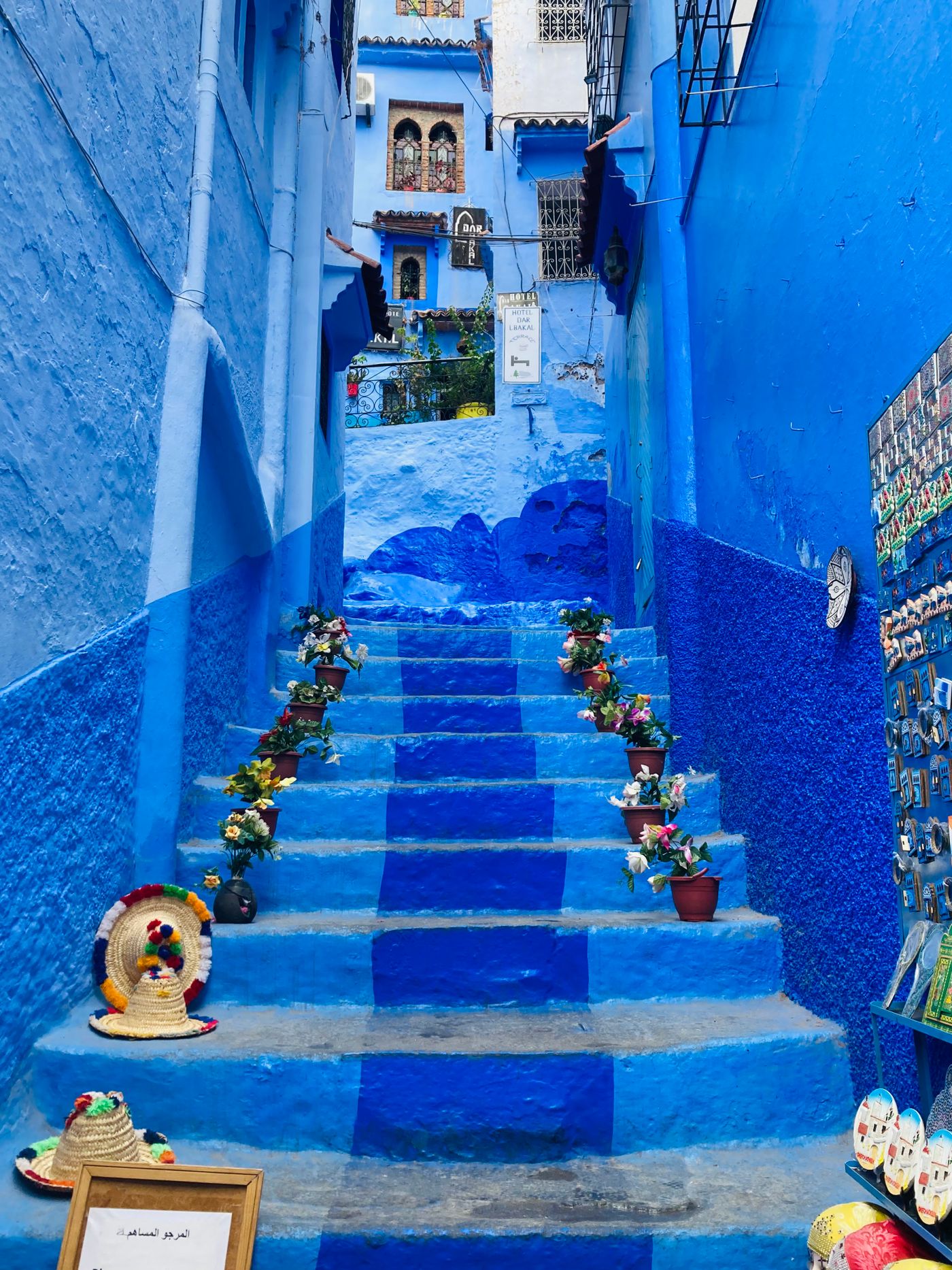
The colour is a big part of Chefchaouen's identity, and the reason many visitors come. But it is not a uniform postcard. Shades range from pale wash to deep cobalt, some walls are faded or whitewashed, and once you leave the old medina the newer parts of town look much like other Moroccan towns.
There is no single agreed explanation for why the medina is blue. The theory most often repeated links it to the town's former Jewish community and the symbolism of blue in Jewish tradition. Others point to practical reasons, such as keeping houses cooler or deterring insects, which are not well established. Whatever the origin, the colour is clearly maintained today, partly because visitors come for it. I would treat anyone offering one definitive answer with polite scepticism.
The most important thing to understand is that many of the most photographed lanes are residential. The doors, steps and flowerpots belong to people who live there, and their front step is not a photo set.
Plaza Uta el-Hammam and the centre
Plaza Uta el-Hammam (also spelled Outa el Hammam) is the main square of the old town and its practical centre. Café and restaurant terraces line its edges, the walls of the kasbah stand on one side, and the Grand Mosque is close by. If you lose your bearings in the lanes, asking for the square is the easiest way back.
It is a good place for a mint tea and some people-watching, especially in the evening. Restaurants on the square trade partly on location, so I would also look for meals in the surrounding lanes rather than eating every meal here.
The kasbah and the Grand Mosque
The kasbah sits in the middle of the old quarter, on the main square. The Moroccan National Tourist Office describes its gardens and a museum collection that includes old weapons, photographs of the town and textiles. I would give it an hour or so — less for the exhibits than for the garden and the sense of the town's older layout. Opening times and entry arrangements can change, so check at the entrance on the day.
The Grand Mosque is one of the landmarks of the square. As with most mosques in Morocco, non-Muslims generally cannot go inside, so it is something to see from the outside.
Ras El Maa: where the town meets the mountain
Ras El Maa is the spring and stream at the upper edge of the medina, where water comes down from the mountain. There are small cafés and drink stalls, a bridge, and a mix of residents and visitors passing through.
I would include it because it is where the tight medina lanes give way to the hillside, and because it is the usual starting point for the walk up to the Spanish Mosque. I would not build half a day around it; a short, unhurried stop is enough for most people.
Viewpoints and sunset: the Spanish Mosque
The best-known view over Chefchaouen is from the Spanish Mosque, also called the Bouzafer Mosque, a small mosque on the hill above town built during the Spanish period in the 1920s. It is not a working mosque in the usual sense, and most people go for the view rather than the building.
A path climbs from the Ras El Maa side. It is an uphill dirt path rather than a technical hike, but it is steady climbing, and how long it takes depends on your pace and where you start. Comfortable shoes and water make it more pleasant.
Sunset is the popular time, and the area in front of the mosque can get busy. Early morning is usually quieter. If you go up for sunset, carry a phone light for the walk down. If the climb is not for you, a roof terrace in the medina — at your accommodation or a café — still gives a good view over the rooftops.
Hills, stairs and getting around on foot
This is the part most people underestimate. Chefchaouen is steep, many lanes end in steps, and the stone surfaces can be slippery, particularly after rain. Vehicles cannot drive into most of the medina, so taxis and cars stop at its edges and the rest is on foot.
- Shoes: grip matters more than style. Polished stone and wet steps are the main hazards.
- Luggage: wheeled suitcases are hard work on steps. A backpack or soft bag is easier. Some accommodations can arrange help carrying bags from the drop-off point, but ask in advance rather than assume.
- Reduced mobility: the medina is genuinely difficult. Choose accommodation close to a point vehicles can reach, ask for directions or photos of the route from the drop-off, and check whether there are stairs inside the building.
- Pace: plan fewer things per day than you would elsewhere. Every outing ends with a walk back, often uphill.
Petit taxis are useful for the stretch between the bus station or the newer part of town and the edges of the medina. Inside the old town, everything is walking.
Where to stay in Chefchaouen
The choice is mostly a trade-off between atmosphere and convenience. Our Morocco accommodation guide covers riads and hotels in more detail; these are the points specific to Chefchaouen.
Inside the medina
The most atmospheric option. You can walk out early, come back easily after dinner, and many guesthouses have roof terraces. The drawbacks are stairs, carrying luggage from the nearest drop-off point and, in some buildings, small or darker rooms. Noise levels depend on the lane.
Close to a medina gate or road access
For most first visits, this is what I would choose. You are still a short walk from the square, but a taxi can get close and the luggage carry is short. It is the best balance if you are arriving with suitcases or late in the day.
Outside the old town
Hotels in the newer parts of town can offer easier vehicle access and, depending on the property, parking. This suits drivers, families with a lot of luggage and travellers with limited mobility. The trade-off is a walk or taxi each time you want to be in the medina.
Higher in the medina usually means better views but more climbing. Before booking, I would check three things: how far the property is from the nearest point a taxi can reach, how many steps that involves, and whether rooms have heating, since nights in the mountains can be cool and winter nights cold. Relative costs are covered in our Morocco travel costs guide.
How to get to Chefchaouen
Chefchaouen has no railway station, so the last part of any journey is by road. The Moroccan National Tourist Office gives approximate road distances of about 194 km from Fes, about 112 km from Tangier and about 65 km from Tetouan. The roads into the Rif are winding, so do not judge journey times by distance alone.
From Fes
The longest of the common approaches. CTM runs coaches between Fes and Chefchaouen; expect the bus to take noticeably longer than driving, and check current departures directly with the operator before travelling. A private driver is more comfortable and flexible, and costs more. Chefchaouen is often paired with a stay in Fes, so this is a very common route.
From Tangier
CTM also runs coaches between Tangier and Chefchaouen. Another option is to travel via Tetouan and continue from there. If you are arriving in Morocco through Tangier, Chefchaouen is a natural second stop.
From Tetouan
Tetouan is the nearest larger city, and the shortest approach. Buses and shared grand taxis are commonly used on this stretch; availability varies, so ask locally on the day.
Driving yourself
The main access roads are paved, but they are mountain roads with bends, slow traffic and occasional poor stretches, and conditions can change after bad weather. Parking near the medina is limited, so ask your accommodation where to leave the car. See driving in Morocco for general advice.
Organised day tours
Day tours from Fes exist, but they mean a very long day with most of it spent in a vehicle. I would only choose one if staying overnight is genuinely impossible.
The bus station sits outside the old town; many travellers take a petit taxi up to the medina rather than walking uphill with bags. For an overview of buses, trains and drivers across the country, see getting around Morocco.
Akchour and walking in the Rif
Chefchaouen sits on the edge of good walking country, and the Moroccan National Tourist Office lists Akchour's waterfalls and Talassemtane National Park among the most popular attractions in the area. Akchour, with its river gorge and waterfalls, is the usual day out.
If you go, give it a full day. You will need transport there and back, usually a grand taxi or an arranged driver, and trail conditions vary with the season and water level — paths can be muddy or slippery after rain. If hiking is not something you enjoy, skip it without guilt. It is a reason to stay longer, not an obligation.
Food in Chefchaouen
Expect familiar Moroccan dishes: tagines, harira, grilled meats, bread and mint tea. Fresh goat's cheese from the surrounding hills often appears on menus and breakfast plates, and is worth trying. Many guesthouses serve breakfast, but whether it is included depends on the property.
I would keep meals simple here and not build a restaurant itinerary. Terraces with views are pleasant, but a view does not guarantee a good kitchen, so it is worth looking at what is on other people's plates before sitting down. For dishes to look out for, see our Morocco food guide.
Shopping: what you'll see
Craft shops are everywhere in the medina. Woven and woollen goods — blankets, scarves, rugs and textiles — are among the most common, alongside leather, woodwork and the piles of coloured pigment powder displayed in front of some shops.
My advice is to buy what you actually like rather than what you are told is unique to Chefchaouen. Look at a few shops before deciding, check the quality of the weave or stitching, and expect prices to be negotiable in many shops.
Photographing Chefchaouen without being a nuisance
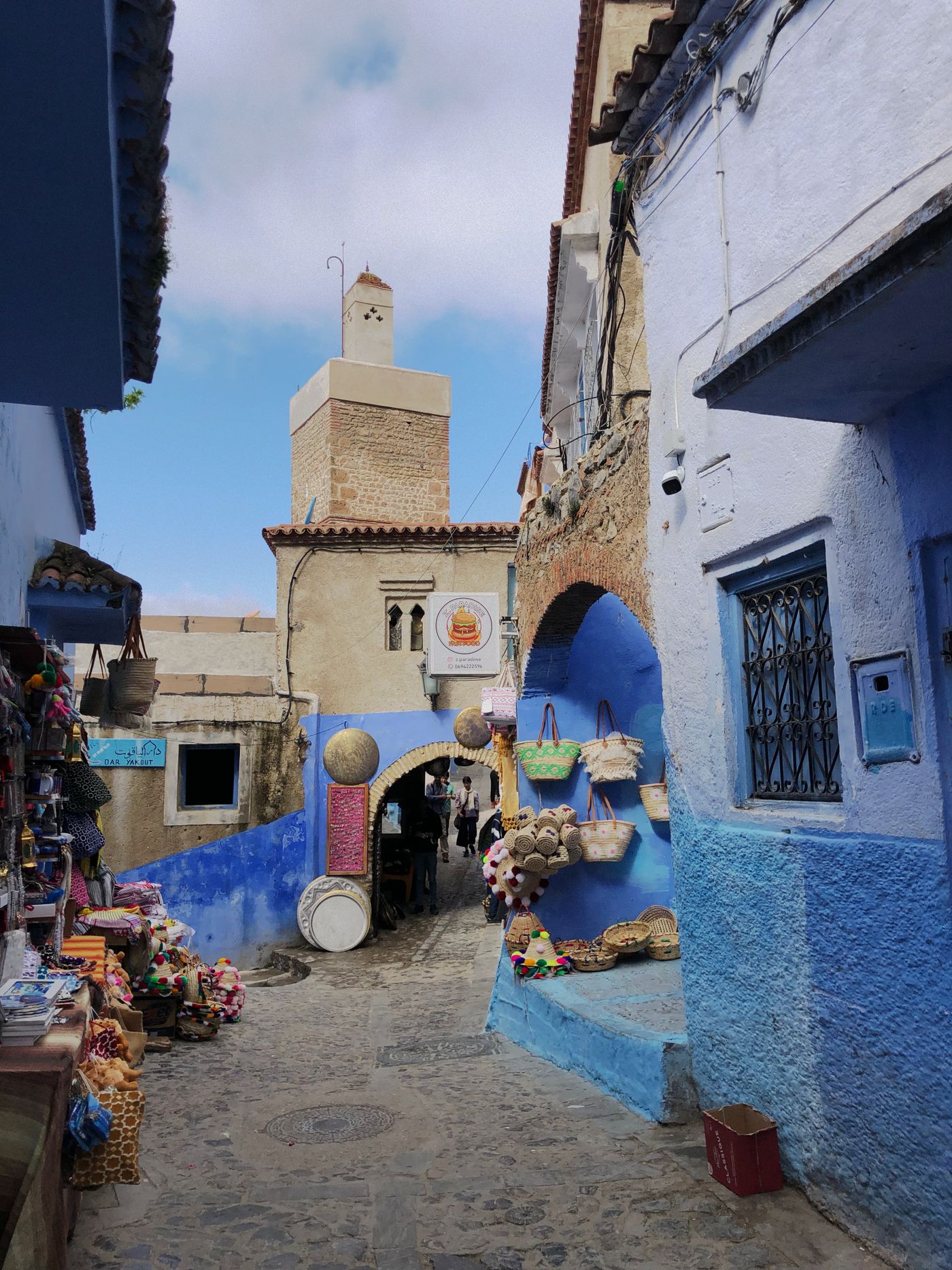
Chefchaouen is easy to photograph, which is exactly why a little care matters.
- Light: early morning usually gives softer light and fewer people; midday tends to be harsher and busier. Overcast days also work well for the blue walls.
- Lanes: many are narrow. Do not block them while you set up a shot, and step aside for residents, children and anyone carrying shopping.
- People: ask before photographing someone, and accept a no.
- Homes: do not sit on doorsteps, lean on doors or move plants and pots for a better picture.
- Residents: if someone asks you to move on, move on.
- Drones: do not bring one without checking current Moroccan rules first; restrictions are strict.
Common mistakes to avoid
- Assuming the town is flat. It is not, and almost every route involves slopes or steps.
- Arriving in shoes with little grip, especially in the wetter months.
- Booking a guesthouse deep in the upper medina while travelling with heavy suitcases.
- Coming only for photos and leaving disappointed by how busy the famous spots are at midday.
- Trying to see everything in a few hours after a long drive.
- Leaving no time simply to walk and sit, which is most of the appeal.
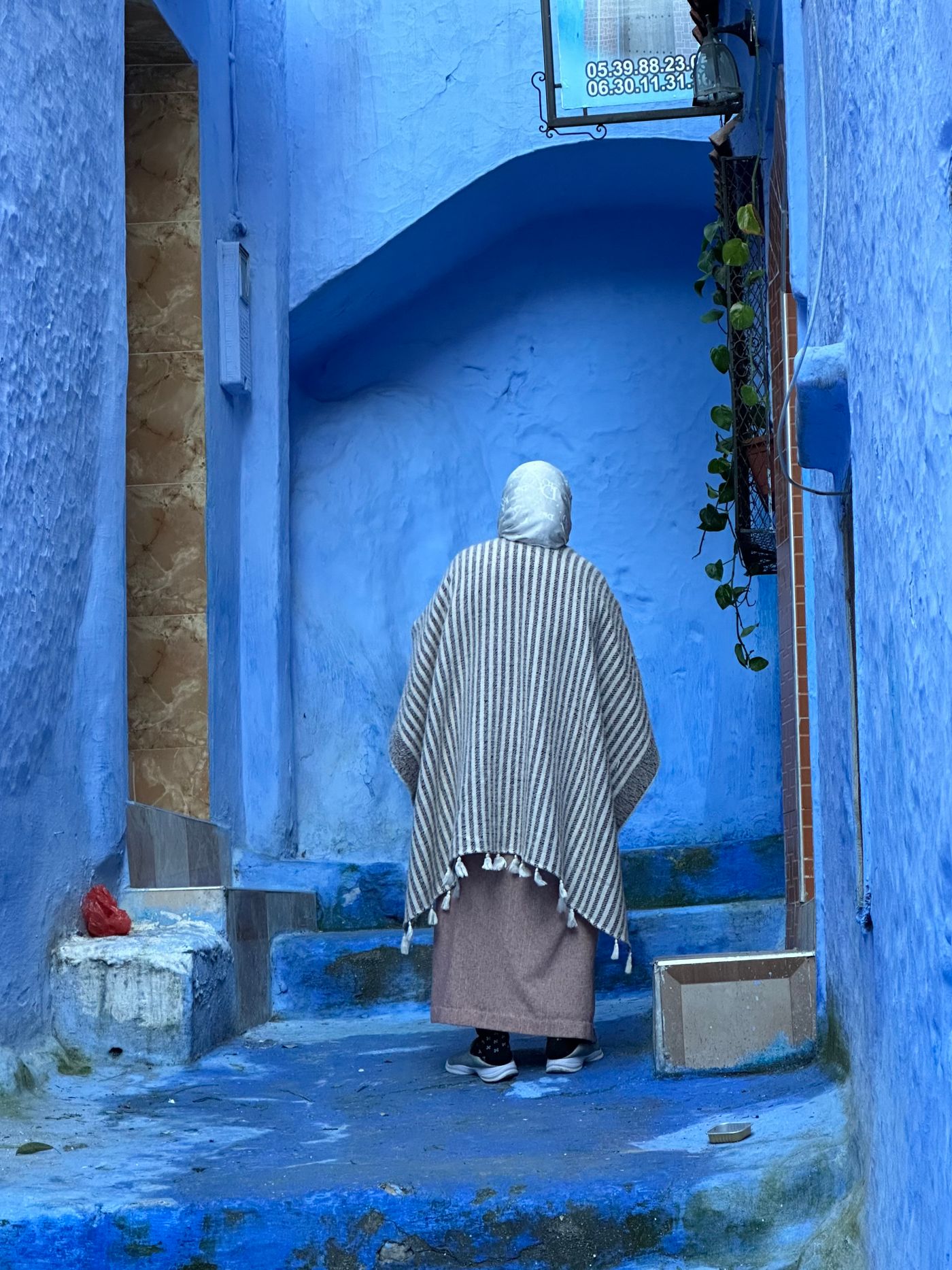
- Treating every blue lane as a public attraction rather than someone's street.
- Filling a short stay with excursions, so you barely see the town itself.
When to go
Chefchaouen is a mountain town, and that matters more than the calendar. In summer, the main issues are crowds and midday heat on the climbs. In winter, cold, damp nights and rain make heating and good shoes more important. Spring and autumn are often the most comfortable for walking, but conditions vary from year to year. Our guide to the best time to visit Morocco covers the seasons across the country.
How Chefchaouen fits into a Morocco route
Geography decides most of this. Chefchaouen sits in the north, so it fits naturally into a sequence such as Tangier → Chefchaouen → Fes, or the reverse, sometimes with Tetouan in between. It fits poorly into a trip built around Marrakech and the desert, where reaching it means a long detour north and back.
- About 7 days: include it only if your week is focused on the north or starts in Tangier. In a first week centred on Marrakech, Fes and the Sahara, it usually costs more travel time than it gives back. See our Morocco 7-day itinerary for how a first week can be shaped.
- About 10 days: possible if you arrive or leave through Tangier, but it means giving up time elsewhere. Our Morocco 10-day itinerary deliberately leaves the north out to keep the Sahara and Fes; if the north matters more to you, one or two nights here is a better use of the time than a shortened desert section.
- About 15 days: there is room for one or two nights and, if you enjoy walking, a day around Akchour. Our Morocco 15-day itinerary shows one way to pace a longer trip.
The detour makes sense when Chefchaouen sits on or near your path between the north coast and Fes, and when you can stay at least one night. It makes less sense when it means doubling back for a single afternoon, or when it would cut a day from places you care about more.
My rule of thumb: add Chefchaouen when your route already brings you north and you can sleep there at least once. If it would only be a rushed out-and-back day, I would rather spend that time elsewhere. For more ideas on where to go, see our Morocco destinations.